Here is the link to my presentation. it is about 21 minutes long. In this presentation i share my findings from my analayis of the nurses who suffered an early death after return from service. A full publication (article) will be published open access and there will also be an essay in the conference proceedings. Copyright Wendy Maddocks.
Monday, March 16, 2026
Monday, October 21, 2024
My latest book on nursing history has just been published. This book involved the transcribing of a diary of the First World War NZ Army nursing sister, and annotating it with additional content, drawing on my research in this area.
The book is available both in NZ ($40 + P & P) and the UK (25 pounds including P & P).
(Other countries can be posted from NZ but will need to check the postage first.
Please email me at nznursinghistory@gmail.com for more details.


Sunday, May 14, 2023
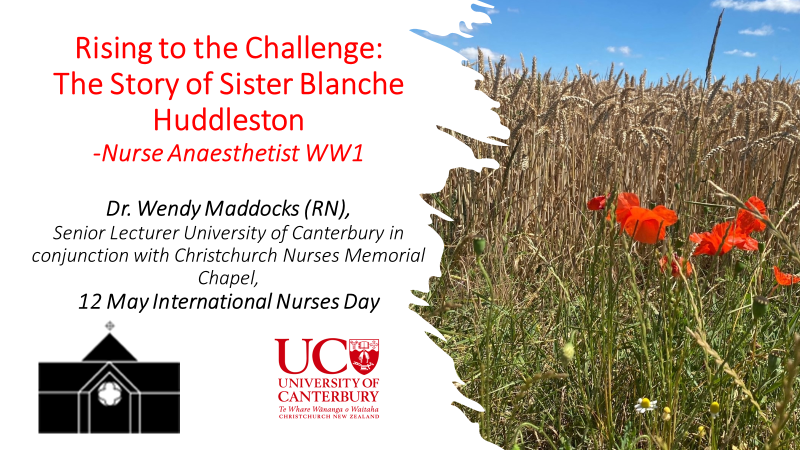
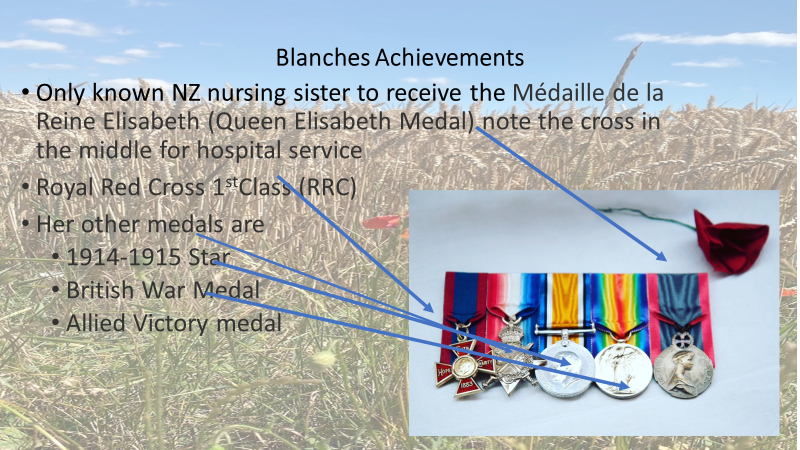
NZ Nurse Anaesthetists of World War One International Nurses Day 12 May 2023
This is a recording of the presentation I gave at the Hisotric Christchurch Nurses' memorial Chapel on International Nurses Day, 12 May 2023.

REFERENCES
Lee, E. (2003). Silencing pain amidst the gunfire World War I and the development of anesthesia. Can Anesthesiol Soc, 18(4).Metcalfe, N. H. (2011). Sir Geoffrey Marshall (1887–1982): respiratory physician, catalyst for anaesthesia development, doctor to both Prime Minster and King, and World War I Barge Commander. Journal of Medical Biography, 19(1), 10-14 https://doi.org/10.1258/jmb.2010.010019.Marr, M. C., Dupanovic, I., Sefcsik, V. Z., Mehta, N., & Chin, E. L. (2020). They Were There: American Women Physicians and the First World War. The Permanente Journal, 24.doi: 10.7812/TPP/20.032McCamish, J., & Hawker, R. (2015). The development, impact and use of anaesthesia in World War One. ACORN: The Journal of Perioperative Nursing in Australia, 28(2), 20-23.Nelson, L. (2018). An Unsung Hero: Anne Penland, Nurse Anesthetist. AANA Journal, 86(2), 64-71.Watson, J. S. (2002). Wars in the wards: The social construction of medical work in First World War Britain. Journal of British Studies, 41(4), 484-510.
Sunday, April 30, 2023


Saturday, April 29, 2023
Book Review
Dr. Wendy Maddocks, RN, DHlthSci, Nurse Academic and aromatherapist
April 2023
Integrating Clinical Aromatherapy into Palliative Care by
Carol Rose

Publisher: Singing Dragon
Available to pre order in Southern Hemisphere from www.woodslane.com.au RRP NZ$69.44
This much awaited book makes an extremely valuable addition
to any clinician, whether aromatherapist or other health professional who is involved
in palliative care. The book easily crosses
the ground between a palliative care clinician with minimal knowledge of
aromatherapy and an aromatherapist with little knowledge of palliative care.
Carol writes from her extensive clinical experience both as a registered nurse
and aromatherapist and uses language in a considered professional way. Evident through
all the text is the profound desire to make this time of someone’s life as comfortable
as possible, whilst upholding principles of safety and efficacy.
The 300+ page is divided into 15 chapters, taking us on a
journey from the background explanation of what palliative care is, through to evidence
based practice then leading us into a detailed chapter on what exactly
essential oils are associated aromatics are. The comprehensive table of key constituents,
plants present tin and possible functions is an excellent resource for any
aromatherapist. Again, the focus is very much on safety and quality.
Chapter three introduces us to the myriad of ways essential oils
can be incorporated, again with safety at the forefront with a brief discussion
of the types of medications and cautions needed (such as not using oils high in
1,8 cineole) which can increase dermal absorption of some drugs. Excellent consideration
of techniques such as compresses, foot baths and the stick inhalers rather than
diffusers. Chapter four talks about resilience and the information in this
chapter reaches far wider than aromatherapy and palliative care- we can all learn
something to apply in our own lives. A case study provides a wonderful example.
The spiritual aspects are explored in chapter five and
introduces the reader to the notion of spiritual distress felt by many
undergoing palliative or end of life care. I especially liked the language around
spiritual assessment, which is not religion dependent. Some aromatic
suggestions are provided to help ease spiritual distress. These notions are
anchored with some excellent case studies.
Chapters, six, seven, eight and nine all approach the
specifics of cancer. Up to this point the term palliative care has care has
been an inclusive term, as not all palliative patients have cancer and not all cancer
patients need palliative care. Each chapter is anchored with at least one case
study. Each chapter highs cancer specific concerns such as pain relief, cancer fatigue
and treatment issues and how aromatherapy can be integrated into management of
these symptoms. There is a very helpful discussion in chapter 9 on the endocannabinoid
system and a brief view of cannabinoid benefits for some of these symptoms.
Chapters ten, eleven, and twelve follow three key pathological
sequelae of palliative and end of life care, regardless of the underlying disease.
Chapter eleven explores breathlessness; chapter twelve looks at all the gastrointestinal
effects (including oral care) and chapter thirteen is all related to the skin.
Each chapter has a solid discussion of the underlying pathology (disease
changes) and the current typical medical treatment. Then an exploration of the possible
evidence-based aromatherapy benefits, again supported with a case study. Each
of these chapters can be used across any number of clinical areas and while
some of the language is technical, by its nature, the information contained is invaluable
to ensure the best treatment is used to manage symptoms without adding any risk
of harm to the patient.
Carol is careful not to exclude the burden on caregiver sand
family members with a loved one undergoing palliative or end of life care. In
many countries palliative care is delivered in the home supported by expert
clinicians reaching out from a hospice service. However, in some cases this is
not so and the burden to provide care falls heavily on family members to
navigate this difficult pathways for their loved ones. Chapter thirteen on resilience also has lessons which relate to
wider life, with lots of handy strategies.
I must admit chapter fourteen had me in tears reading the
case studies of the last moments of life and how aromatherapy can assist. Some of the content on grief was valuable, and
my only suggestion here is I would have liked to seen the seminal work by Dr
Lois TonkIn, about growing around grief, mentioned, which grew out of the recognition
that grief doesn’t go through stages as initially posited by Kubler-Ross.
The final chapter is a short chapter with good suggestions
for the way to move forward through more research, better quality research and early
referral to integrated palliative service.
Then follows the exceptionally strong reference list
In conclusion
Carol’s book makes a
considered and valuable addition to aromatherapy and palliative care. It is not
a book of recipes for problems, rather than approach is to provide detailed background
to what the issues are, what can be done to help and comes from a position of the
reader having some sort of baseline understanding of patient care and medical language.
Whilst I would not consider this a book for beginning practitioners of
aromatherapy, I do consider it an essential one for anyone who wishes to expand
their knowledge. It should be available in every hospice as a reference book
and used as a reference in any courses
about palliative care. Congratulations Carol for bring this book to life.

Wednesday, November 2, 2022
 "Broken Nurses Research"
My other passion is Nursing history and I recently presented at the great war group conference in Chester, UK. This is a summary of the presentation I gave which is part of a research study I am currently undertaking. The following is a zoom recording. The title of the presentation is called "Broken Nurses". copyright Wendy Maddocks
Sunday, November 14, 2021
Covid Advice 2021
As we in New Zealand, like the rest of the world, come to realise that COVID-19 and the long covid effects are going to be around for a while yet, it is only natural that people are looking for solutions to help. You may wonder what qualifications do I have to comment- firstly I am a registered nurse with past experience in critical care, I am also trained in clinical aromatherapy for over 25 years, have studied, researched and taught it. My doctorate degree explored the use of essential oils in the side effects of cancer treatment. I maintain my currency by reading scientific journals and attending scientific conferences. I don't listen to marketing. I have recently completed a review of some 250 clinical studies on aromatherapy.
First up I am going to be very frank and that vaccination is the first and most important tool in our toolbox. Without this the virus will continue to mutate and seek out the most vulnerable. This is already happening in the countries of Africa, where there are low vaccination numbers and other strains emerging. Barely a year ago the global community could only hope a vaccine could be developed, and now there are several available. this blog post is not about the merits of one type of vaccine against another. Science and history tells us vaccines save lives, and for COVID-19 if we are unlucky enough to catch it even though vaccinated, it significantly reduces the severity of our symptoms and reduces the chances of us needing hospital care.
Let me also be very clear, COVID-19 is not 'just a flu' (remember influenza is also a potentially fatal infection and not something to be brushed off). Just a few short years ago we had the Swine flu in NZ and healthy young people died.
Tuesday, November 9, 2021
The Safe Use of Aromatherapy in Cancer Care

(c) Wendy Maddocks 2021
Tuesday, October 26, 2021
Antifungal Effects of Kānuka Oil- Kunzea ericoides

Please look at my latest research on Kānuka oil on two common pathogenic dermatophytes.
Geographical location has an impact on efficacy https://www.essencejournal.com/pdf/2021/vol9issue2/PartA/6-6-70-303.pdf
Friday, May 21, 2021
Essence of Clinical Aromatherapy Presentation 21 May 2021
Kia ora
thanks for watching the presentation!
The presentation is now publicly available here. This link takes you to the youtube link.
here is the reference list for the presentation. Please note the two articles are still with the journal publishers being reviewed and will they are accepted for publication I will post links here. This reference list is just of the articles which I reviewed and is not the entire reference list for the articles.
the link to the list is here
Best wishes Wendy
Wednesday, December 2, 2020
The use of natural Supplements and remedies by New Zealanders during the 2020 Covid Lockdown; A survey
The use of natural supplements and remedies by New
Zealanders during the 2020 COVID 19 Lockdown: Survey
Dr. Wendy Maddocks (RN, DHlthSc) wendy.maddocks@canterbury.ac.nz
July 30, 2020
This survey was completed just after
the level 4 COVID 19 lockdown in May 2020. The survey was live for two weeks
when the country moved to level 3 and before level 2 commenced. You indicated
you would like a copy of the results. Please be assured your results could not
be personally identified in the study and the request for results was separated
from the survey.
A full analysis
and article has been submitted for publication in an international peer
reviewed journal July 30 2020. This is an executive summary of the key findings
of the study. Some details have been omitted to protect privacy of
participants.
The request to
participate in the online survey was posted on Facebook, Linked In, Twitter and
several online chat forums and participants were asked to share the survey with
their own networks.
A total of 124
surveys were completed correctly with all participants indicated they used some
form of natural remedies.
Demographics
89% of respondents
were female and 79% were aged between 36-65 years old.
80.73% respondents
identified as New Zealand European/Pākeha
95% of respondents
spent lock down in their own home
No respondents had
tested positive for COVID 19 or been in quarantine or isolation at that time
Results
31.7% had
increased their use of natural remedies and supplements in direct response to
the risk of COVID19. Supplements chosen had a perceived antiviral or immune
boosting effect. Vitamin C was the most popular remedy chosen. Most people
purchased their supplements either at a supermarket or pharmacy with only 6.5%
obtaining supplements from a qualified practitioner. Five percent of
participants prepared their own remedies. Around 40% told their Dr or
registered health professional about their use of supplements or natural
remedies. The remainder either didn’t or were selective in what information
they gave depending on what they were seeing the Dr. about. The following
images provide further summary of findings.
Full article available by subscription from https://journals.cambridgemedia.com.au/ajhnm
Table 1
|
Remedy/Supplement |
% used |
|
Vitamin C |
62.14% |
|
Multivitamin/mineral supplement |
57.14% |
|
Commercial herbal teas |
43% |
|
Essential oils/aromatherapy |
35.58% |
Subscribe to:
Posts (Atom)